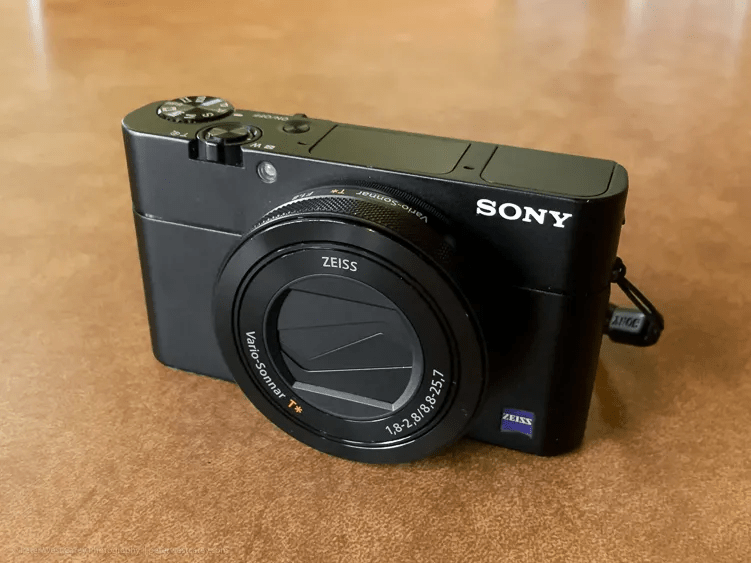
Sony’s RX100-series created the large-sensor compact camera category. Now, the Sony RX100 V takes it to the next level with performance that can blow away most best camera for personal use interchangeable-lens cameras, yet in a package that can slip almost unnoticed into your pants pocket. And thanks to that big image sensor, the RX100 V’s 20-megapixel stills and 4K video offer top-notch quality to boot. But can that justify its steep pricetag? Find out now in our in-depth Sony RX100 V review!
Pros
Pocket-friendly design; Unbelievably fast burst capture; Generous buffer depth, even for raw; Fast and confident autofocus; Very high resolution gives lots of detail in good light; High ISO noise levels much better than most pocket camera rivals; High-quality 4K video with uncompressed HDMI out; Super-fast High Frame Rate video
Cons
Very pricey for a compact camera; Still no touch screen; Slow buffer clearing; JPEGs can look over-processed at higher ISOs; Lens doesn’t offer much telephoto reach; Battery life is very modest; 4K movies are limited to five minute clips
Price and availability
Available since October 2016 in North America or November 2016 in Europe, the Sony RX100 Mark V carries US-market pricing of around US$1,000. That’s the exact same pricepoint at which the RX100 IV launched. In Canada, pricing is in the region of CA$1,250, while in Europe pricing is about 1,200 euros.
Almost identical to the RX100 IV in terms of body design, sensor resolution, lens and controls, the Sony RX100 V differentiates itself by providing greater full-res burst capture performance and burst depth than we’ve ever seen in such a pocket-friendly camera.
The Sony RX100 V is all about performance
For the fifth generation in the RX100-series, Sony has clearly focused on performance. The Sony RX100 Mark V is simply unrivaled in this area: It can shoot full-resolution images at a truly staggering 24 frames per second, and that’s with autofocus and autoexposure adjustments between frames. (For bonus points, you can also enable silent shooting at this rate, so you won’t even distract your subject.)
And that performance is not available just for a handful of frames, either: A roomy buffer allows space to store as many as 150 JPEG frames at full resolution, and even raw shooters should be able to manage an impressive 72 frames in each 24-fps burst. Even if you favor raw+JPEG capture, you should be able to shoot around 62 images in a burst, a fair bit more than twice as many as was possible with the RX100 IV. (And all of those figures are from our in-house testing, incidentally. Sony’s own claim of 150 JPEG frames in a burst nicely matches our own findings.) See our Performance page for details.
A new hybrid autofocus system with more points than you can shake a stick at
Sony has achieved this level of performance in part thanks to a redesigned image sensor with a brand-new hybrid autofocus system. The RX100 V’s new 20.1-megapixel image sensor might not offer any higher resolution than the previous generation, but it now includes a generous 315 on-chip phase-detection autofocus pixels. These cover 65% of the image frame, besting the recently-cancelled Nikon DL-series cameras by around 5%.
The on-chip phase-detection pixels are first used to quickly determine the required focus adjustment and direction. To complete the AF cycle, the system switches to using contrast-detection to fine-tune the precise point of focus. And you can manually adjust both the AF drive speed and tracking sensitivity.
The result, according to Sony, is “professional-level AF performance” capable of determining a focus lock in just 0.05 seconds. (Our own in-house testing using center-area autofocus at wide angle and telephoto positions turned in times of around 0.19 to 0.21 seconds, very respectable performance for such a compact camera.)
 Site Title
Leave a comment